


Land Management & Environment
Land Management and Environment Division (LMED) oversees different aspects of land use planning and implementation, environmental management and monitoring for our community. These include policies and procedures related to the Community Master Plan, Zoning Law and its applications, Lot allocation procedures, Environmental Protection Law, monitoring of forestry-related activities and other developments. The LMED team is available to provide further information and understanding to these different processes, assist in their application, while ensuring compliance to the established measures and laws. LMED welcomes the opportunity to provide reliable and valuable service to our community members.
COMMITTEES
The Coordinator of Land Management and Environment is part of the Panel that consists of CNG and Quebec representatives concerning forestry activities within Category 2 lands. There are 4 meetings planned for each year.
The Stornoway Diamond mine environment committee was established by virtue of the Mechesoo Agreement. This agreement was between the Company and Cree Nation of Mistissini and also includes the CNG. The members on the EC are 3 representatives from Stornoway, 2 from Cree Nation Government and 2 from the Cree Nation of Mistissini. There are four quarterly meetings in a year and the Committee is well informed by the Company on Environment matters relating to this mining project. Presently, this mining project is on Production Phase and the Company has started Producing Diamonds in the fall of 2016. The Coordinator of Land Management and Environment is an alternate member of this committee.
This Commission is led by the CNG, the Coordinator of Land Management and Environment was appointed by the Council of the Cree Nation of Mistissini to sit on the Eeyou Planning Commission (EPC) for Category 2 lands representing Mistissini. This Commission has quarterly meetings and the first one was held in Ouje-Bougoumou in July 2016. There is one Commissioner and an Alternate member for each of the 10 Cree communities. The functions of this Eeyou Planning Commission will be Land Use and Resource Planning on Category 2 lands.
ENVIRONMENTAL PROJECTS
Monitoring the quality of the drinking water within the community continues to be one of the main mandates of the Local Environment Administrator (LEA). Working in collaboration with the Water Operators under the Public Works Department, on-site testing of the drinking water is conducted two times per week with results received within 24 hours. Along with the Colilert testing, weekly sampling for physicochemical characteristics of the drinking water is analyzed through an accredited lab in Montreal.
Results from drinking water tests are monitored by the Water Operators, the LEA office as well as departments within the Cree Nation Government (CNG), Quebec Ministry of Health, and Cree Health Board.
The LEA continues to work with Public Works Department as they carry out the management and operations of each waste facility in the community; i.e. garbage collection, landfill site, recycling, cardboard bailing, eco-centre, hazardous waste, etc. The LEA is responsible for monitoring the operations of all waste management facilities to ensure compliance of provincial regulations.
Environmental site assessments are carried out each year within the community. Prior to occupation of a residential, commercial, institutional or industrial lot, a Phase 1 ESA is conducted to examine the condition of the lot to ensure no actual or potential contamination is present. These are applied to both newly developed and existing lots.
With the continuation of the walleye management project, which began in the spring of 2016, sampling and monitoring of this species during the 3-4 week spawning period took place once again in May 2018. Working in collaboration once again with the impacted tallymen of the Chalifour, Perch and Icon River areas, community residents seen fishing during the spring spawning period were asked to limit the number of walleye they caught, were requested not to use fish nets or snares and were not permitted to fish at night.
Funding for the fish management plan was provided by the CNM and Niskamoon Corporation. The walleye management project was merged with a 2-year multi-species fish population monitoring and research project, which began in June 2017. Using data and samples collected in fish studies carried out in Mistassini Lake, as well the combined methods of Cree knowledge and scientific research, the 2-year project examined life history (body size, age) and molecular attributes (genome-wide DNA variations) to assess changes in body size, effective population size and/or population structure over time in walleye, pike, lake trout and brook trout. Results from these studies will be presented to community members once final reports are completed in August 2019.
Through the approval of a funding application to MAPAQ (Ministère de l’Agriculture, des Pêcheries et de l’Alimentation du Québec) and the Renard Business Development Fund, the environment office has been able to work on building a 5-year plan for agriculture development for the community. This project has been well-received by many community residents; input was gathered through surveys and focus groups and we are currently working on drafting the plan for review by community members. Completion of the project is expected by September 2019.
Cree Nation Government (CNG)
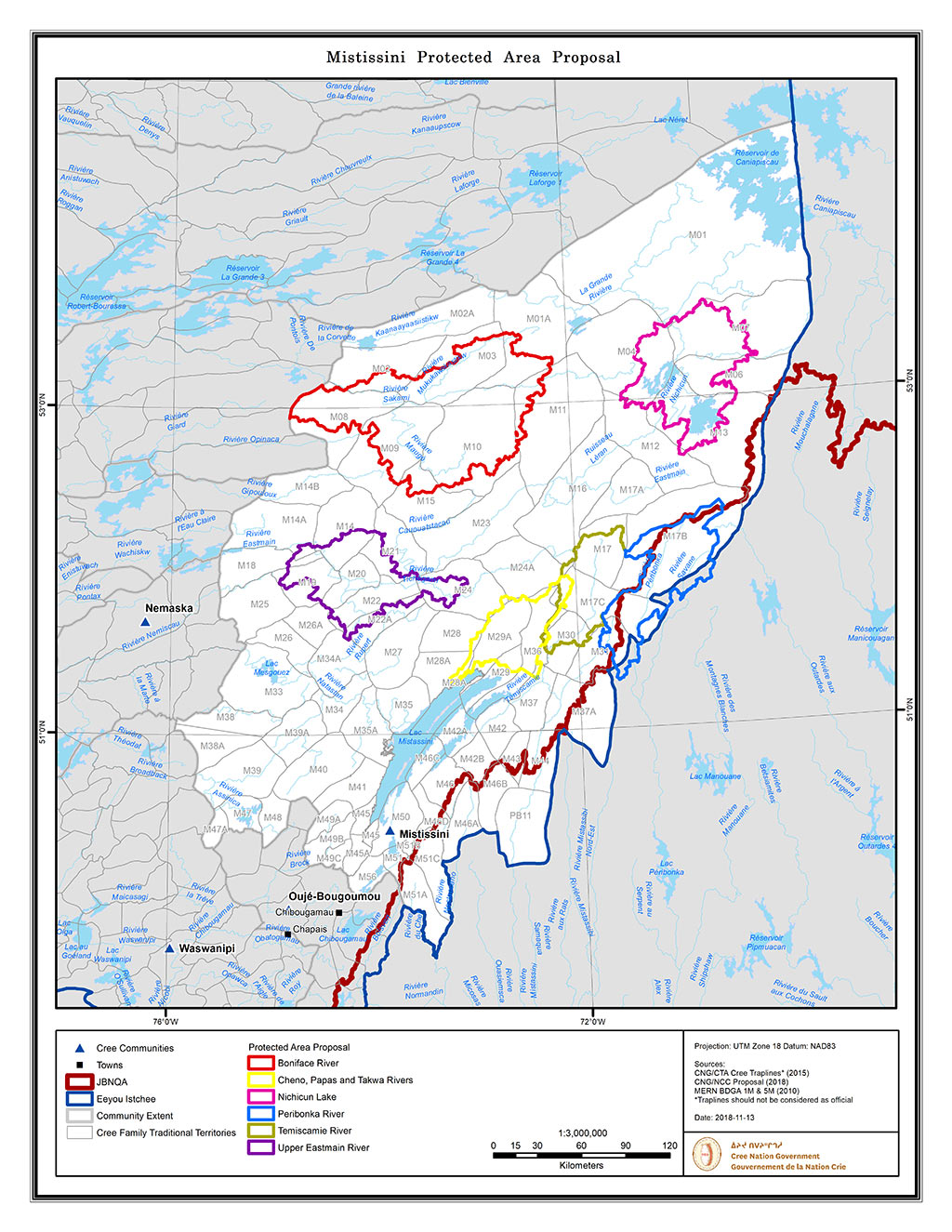
Protected Areas (map)
Over the last few years, work has been carried out to collaborate with the CNG in identifying and establishing protected areas within Mistissini territory. As part of the Cree Regional Conservation Strategy (2014) and Cree Vision of Plan Nord (2011), 20% of Plan Nord territory is to be formally designated as protected areas, meaning industrial development such as forestry, mining and hydro would be prohibited within these areas.
LAND REGISTRAR/GEOGRAPHIC INFORMATION SYSTEM
Community Master Plan
The Community Master Plan was created out of a need to represent clearly how the development of our community will be approached 5, 10 or 15 years into the future. The plan is closely aligned with the Zoning Law (Discussed in detail below) incorporating residential, commercial, industrial and institutional also temporary lots within the scope of the Community Master Plan. This will be a core tool in decision making not only to make our community able to accommodate more diverse needs but to balance the way that lots are allocated to various projects.
The Community Master Plan is reviewed each year by the Land Management and Construction Committee with professional assistance from Urban Planners from Montreal (Zep Tepi). This Master Plan as it progresses into the future will also be reviewed by the Management Committee and Chief and Council to ensure that a broad review is part of its development.
The success of the Community Master Plan comes from its integration of proper Zoning Laws as well as a regular and timely updating of areas of zoning. A community as it progresses will assume new needs and a master plan needs to account for this to remain a representative plan into the future.
The Zoning By-Law is a legal document intended to establish the procedures, guidelines and regulations that designates specific zones for development related activities. Currently the By-Law is structured around 4 major areas of development including Residential, Commercial, Industrial and Temporary Lots and sub sections of development within Industrial. The By-Law will state exactly the land-uses that will be permitted in specific zones and provide standards for issues such as lot size, building height, set-back from the street, parking areas etc.
These lots include over seven designated structures including duplexes; triplexes single family housing, row houses, apartments, institutional housing and trailers. These buildings are intended to be used as a residence and secondary use of these structures are not permitted under the by-law. In such case that activity is permitted it may not take more than 25% of the residential space of the dwelling. In addition to guidelines of use the law the Community Master Plan is also reviewed each season to designate which residential lot areas to be developed and to include Environmental Site Assessments and technical descriptions of the lot.
All establishments designed, used or intended for the retailing of goods, services or merchandise. Commercial uses must not be the cause any nuisances. This land use category permits the following uses, without being limited to: grocery stores, restaurants, chip stands, hotels/motels, banks, gas stations etc. Commercial Lots represent a lower volume of requests throughout the year for two reasons. First, the availability of commercial space presents a key challenge to lot allocation within our growing community. Second, the Commercial Lot allocation process requires that the business be evaluated and comply with Economic Development’s standards and guidelines for business permitting. These two processes can take some time, requiring up to six months to follow through to completion.
In addition, a more stringent environmental site plan may be required for fuel stations, car washes or light commercial activities before being issues a permit. This process while requiring a greater degree of rigor will protect our community from unanticipated issues with the development of specific projects.
All establishments designed, used or intended for educational, cultural, health, welfare, religious or public administration purposes. This land use category permits the following uses, without being limited to: churches, daycares, youth centers, arenas, training centers, libraries etc. These lots also provide planning for Sports Fields, Cultural Buildings, and Tourism Cabins. The primary purpose of institutional lots is to provide core areas of service, administration, recreation and cultural value to our community. Unfortunately we do not have much to offer for larger institutional lots at the moment.
All establishments used or designed for industrial purposes and heavy utility. Due to its usually disturbing nature (noise, pollution, odors, visual pollution, etc.), the land use can represent a nuisance for people living nearby and should then be kept away from residential, institutional or sensitive natural zones. This land use category permits the following uses, without being limited to: garages, warehouses, cement plants, quarries and gravel pits, telecommunications towers, as well as waste disposal sites.
These areas are part of core utilities and essential services within our community and will be essential as development progresses. Of particular significance is the development of Heavy Equipment Depos and areas for storage of material and equipment. These will ensure that residential storage of equipment diminishes in the future while providing an area where environmental monitoring and contingency can be accounted for.
Temporary Sites are issued for a specified duration for outside contractors that require a space to conduct their business. Often these requests are related to specific construction projects and when reviewed by the LMCC the aim to provide a lot that is as close to the construction site as possible. These lots are not designated on a permanent basis and upon completion of their project the contractor is expected to demolish and/or remove all items from the site.
The Zoning law was finalized by the Land Management and Construction Committee (LMCC) and again with ZEP TEPI. The Urban Planners that have been working with LM-E for the past few years. The document has since undergone review by Chief & Council and was approved. These have since been reviewed by the Department as well as the Land Management and Construction Committee. We anticipate that the review by Chief and Council will advance the law towards completion and implementation.
Upon its implementation within the community an Administrator will be part of the monitoring and enforcement of the law. This role will also be administrative in its capacity working to monitor, register and provide core data on lot usage within our community. The Law will ultimately be a legal document with a capacity to be enforced on all future construction projects. In the event that a project does not comply with the standards, regulations and guidelines then it will be at the discretion of the Land Registrar’s Office to not issue a permit and/or revoke a permit.
Cottage lots along the community shoreline and category 1A and 2 lands present a growing area of attention with land planning as well as environment monitoring. The potential for environmental impacts due to tree felling, sedimentation, and land filling requires a standard approach that can reduce these potential environmental concerns. For this reason the Cottage Lot Law was developed and will be adopted within the 2019-2020 fiscal year by an executive committee.
Cottage Lots are available to members of the Cree Nation of Mistissini either on the north or south side of the peninsula. Those who wish to know more about the lot availability can request this information from the Land Registrar’s Office. When a lot is approved for use the recipient must comply with all conditions of the law including specific conditions for septic systems, maximum areas of shoreline clearance and creation of secondary structures including sheds and docks.
Globally, there are over 200 lots that are shown for cottage usage. With the approval of the law we anticipate that the approval of requests will become more streamlined and efficient. However, notifying recipients of their responsibilities and services they will be required to develop their project will be critical to the success and sustainability of shoreline development.
Learn about Lot Allocation Procedure and Registration or Contact us today if you have any questions.